Rye Brown-Butter Cookies with Dark Chocolate Puddles
Rye flour, brown butter, hand-chopped dark chocolate, and a touch of molasses — the chocolate chip cookie that doesn't taste like every other internet chocolate chip cookie.
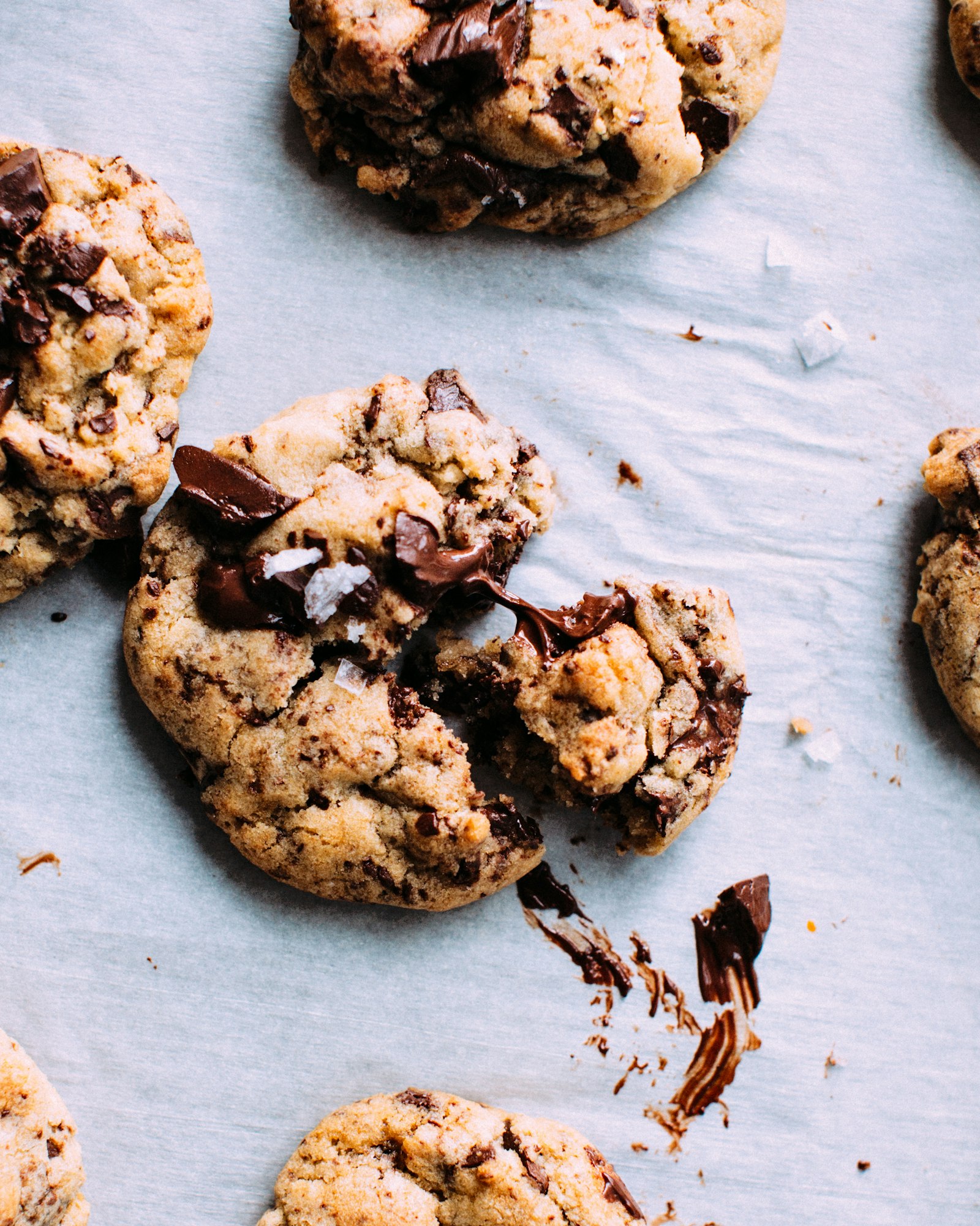
I went looking for a chocolate chip cookie that didn’t taste like every other internet chocolate chip cookie. Rye flour was the answer. It tastes faintly of toasted hazelnuts and gives the dough a structural chewiness that holds up to whatever chocolate you can throw at it. Chop your chocolate by hand — I know it’s a step, but the puddles you get when chopped bar chocolate melts into the cookie are not the same thing as chips.
The twist that makes this one mine: rye flour. Specifically, swap a third of the all-purpose flour for whole-grain rye, which gives the cookie a nutty, almost-malted depth that plays unbelievably well with brown butter. Rye also absorbs liquid differently, which means the cookie holds taller and chewier without needing an overnight chill. The other changes: less white sugar, more brown sugar with a tablespoon of molasses for a fudgier middle; one whole egg plus a yolk (instead of two whole eggs) for a richer texture; chopped 70% dark chocolate bars cut into uneven shards instead of chips, so you get puddles of melted chocolate instead of round chips.
Why this works
Rye flour has fewer gluten-forming proteins than wheat and a higher amount of pentosans, which absorb water differently — the result is a softer, slightly cakier interior with a chewier edge. The molasses + reduced white sugar shifts the cookie toward fudgy without making it overly sweet, and the egg-plus-yolk move (instead of two whole eggs) lowers the water content and increases the fat ratio, which means the cookie spreads less and holds taller. Chopping bar chocolate by hand gives you both fine shards (which melt into the dough and tint it) and big chunks (which become puddles), and that textural variety is what makes the cookie taste hand-built. Brown butter at 360°F instead of 375°F gives the rye time to toast in the oven without burning the edges.
Make ahead
The dough actually improves with a 24- to 48-hour fridge rest — the rye flour fully hydrates and the flavors deepen. Scoop the dough into balls, refrigerate up to 3 days, and bake straight from the fridge (add 1 minute).
Freezer notes
Scoop the dough into balls, freeze on a parchment-lined tray until firm, then transfer to a zip-top bag — keeps 3 months. Bake from frozen at 360°F for 14 to 16 minutes. This is the freezer move I’d actually recommend over baked-and-frozen cookies; fresh-baked from frozen dough is dramatically better.
Ingredient swaps
- Whole-grain rye → spelt or whole-wheat pastry flour: A different but equally interesting cookie. Avoid plain whole wheat; it’s too coarse.
- Both chocolates → 10 oz of one chocolate: Use 70% if you want sophisticated, 60% if you want comfort.
- Molasses → 1 tbsp dark corn syrup or honey: Slightly less depth but still chewy.
- Granulated sugar → Demerara or turbinado: Slight crunch, slightly more caramel.
Sarah’s kitchen notes
Rye flour doesn’t sit in most pantries. King Arthur sells a whole-grain rye that’s perfect for this — it’s the one I keep in a quart-size jar in the freezer, and it lasts forever there. (Whole-grain flours go rancid faster than refined; freezer is right.) The other thing nobody tells you: when rye flour is fresh, it smells amazing — like a warm bread oven — and that’s the smell you want going into the dough. If your bag has been open for a year, replace it before making these. It matters.
Ingredients
Instructions
- Brown the butter with intent. Melt the butter in a light-colored saucepan over medium heat. Once it's melted, swirl the pan often. It will foam, then quiet, then start smelling like toasted hazelnuts and look amber, with brown specks at the bottom. Total time: about 7 minutes. Pour into a heatproof bowl, scraping every speck — those bits are the flavor. Cool until just barely warm to the touch, about 25 minutes. (If you're impatient, 15 minutes in the fridge.)
- Heat the oven to 360°F (yes, 360, not 375 — slightly lower to give the rye time to develop flavor). Line two sheet pans with parchment.
- Mix wet. In a large bowl, whisk the cooled brown butter with brown sugar, granulated sugar, and molasses until glossy, about 1 minute. Add the egg, egg yolk, and vanilla. Whisk hard for 30 seconds, until the mixture lightens slightly.
- Mix dry. In a separate bowl, whisk all-purpose flour, rye flour, baking soda, and fine sea salt.
- Combine. Pour the dry into the wet and stir with a spatula until just barely no streaks remain. Fold in both chocolates.
- Scoop big. Use a #16 disher (about 3 tablespoons / 60g per cookie) — you want them generous. Place on a plate or sheet, cover loosely, and chill 30 minutes. (Overnight is better but optional.)
- Bake. Place 6 cookies per sheet, well spaced. Bake one sheet at a time, 11 to 13 minutes — pull them when the edges look set and the centers still look slightly underdone and shiny. Right out of the oven, sprinkle with flaky salt. If you want clean round shapes, swirl a biscuit cutter around each cookie while still hot.
- Cool on the pan for 10 minutes before moving. They finish setting as they cool — that's the chew.
Notes
- A 24- to 48-hour fridge rest deepens the flavor and lets the rye fully hydrate. Bake straight from the fridge — add 1 minute.
- Whole-grain flours go rancid faster than refined. Keep your rye in the freezer.
- Chop bar chocolate by hand. Chips are uniform; shards give you puddles.


